Managing Customers Through WhatsApp and Email: The Hidden Costs Businesses Overlook
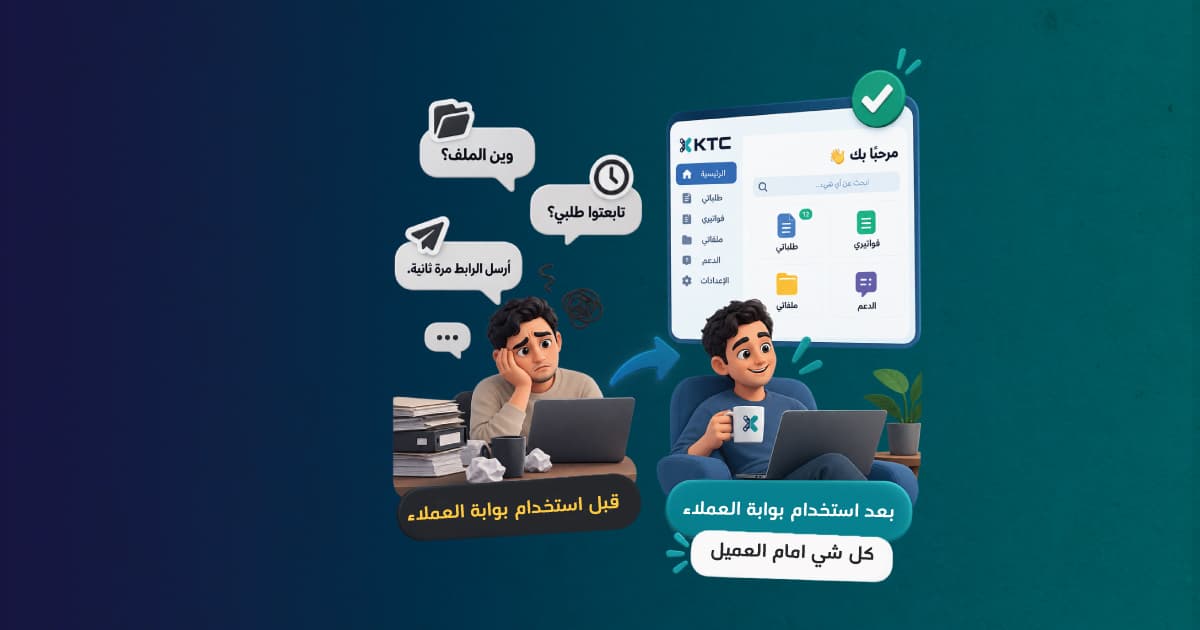
One customer submits a request through WhatsApp, another asks for a document via email, one employee records notes in an Excel spreadsheet, while another keeps project updates in a separate conversation.
Everything seems under control.
But problems begin when the number of customers increases, files and requests multiply, and teams expand.
Suddenly, the challenge isn't just the amount of work. It's where that work is being managed.
Information is scattered, requests arrive through different channels, and employees spend a significant portion of their time searching for information and following up instead of completing their actual tasks.
This is where the true cost of fragmented customer management becomes apparent.
The Problem Isn't WhatsApp or Email
WhatsApp is an excellent tool for quick communication, and email remains essential for formal business correspondence.
The problem begins when communication tools become your customer management system.
There's a significant difference between using WhatsApp to communicate with a customer and relying on it to answer questions such as:
- What was the customer's latest request?
- Who is responsible for handling it?
- Has anyone responded?
- Where are the relevant files?
- Which version of the document is the latest?
- What's the current project status?
- Are there any overdue requests?
When the answers to these questions are buried in scattered messages and conversations, operational chaos begins.
1. Time Wasted Searching for Information
One of the most significant hidden costs that rarely appears in financial reports is the time employees spend searching.
Searching for a file.
Searching for the latest version.
Searching through an old conversation.
Searching for the employee who previously handled a particular customer.
Each situation may take only a few minutes, but when repeated dozens of times a day, those minutes turn into hours of work that generate no real value.
The problem isn't that your team isn't working.
It's that they're spending their time trying to access the work instead of getting it done.
2. Duplicated Work
When information isn't centralized, the same tasks start being repeated.
One employee sends a file that another employee has already shared.
A team member answers a question that was previously addressed.
A customer requests another copy of a document because they can no longer access the original link.
And your team ends up collecting information again that should already be stored in an easily accessible location.
All of this creates additional costs without adding any value.
3. Knowledge Lost in Conversations
What happens when the employee responsible for a customer is absent?
Can another team member easily find out what was agreed upon?
Or do they have to go through dozens of messages and conversations to understand the full situation?
When customer knowledge is tied to a specific employee, your business faces a problem far greater than losing a file.
It risks losing context.
And context is what enables your team to understand customers and deliver consistent service.
4. Multiple Versions of the Same File
A customer sends a document.
An employee makes some changes.
The updated file is sent by email.
Then another version is shared through WhatsApp.
A week later, the question arises:
Which version is the latest?
Multiple versions of the same file are among the most common problems in message-based workflows.
As the number of customers and projects increases, so does the risk of using outdated files or sending incorrect versions.
5. Limited Customer Visibility
Your team isn't the only one affected by fragmented processes.
Your customers are affected, too.
When customers want to check the status of a request, there's no clear place to find the information.
When they need a document, they have to send a message.
When they want the latest update, they have to call or contact the employee responsible.
This makes customers entirely dependent on direct communication, even for the simplest information.
Over time, the experience becomes slower and less efficient for everyone involved.
When Should a Business Change the Way It Manages Customers?
Not every company needs a customer portal from day one.
However, several warning signs may indicate that your current approach is no longer sufficient:
- Customers repeatedly ask the same questions.
- Customers frequently request files to be resent.
- Tracking the status of requests becomes difficult.
- Customers depend heavily on specific employees.
- Multiple communication channels are used to manage the same customer.
- Your customer base is growing rapidly.
- Training new employees to manage customer relationships becomes increasingly difficult.
- Important information is stored in personal conversations.
When these signs appear, the problem isn't necessarily your employees.
It's the system they're working with.
From Fragmented Communication to a Centralized Experience
Customer portals don't eliminate the need for email or other communication channels.
Instead, they give each tool its proper role.
Communication channels can still be used for conversations, while the customer portal becomes the customer's central point of reference.
Through the portal, customers can access their files, requests, updates, and support tickets in one place.
Meanwhile, your team can manage information more clearly and efficiently.
Instead of asking, "Where's the file?" customers can simply log into their accounts and find it.
Instead of asking, "What's happening with my request?" they can see the latest update directly.
This is where technology evolves from being just another tool into a better way to manage customer relationships.
Conclusion
If your company increasingly relies on WhatsApp, email, and scattered conversations to manage daily customer operations, you may not need another communication channel.
You may simply need one centralized place that brings all these processes together.
At KTC, we develop customized customer portals and software solutions that help businesses transform fragmented processes into an organized, scalable digital experience.
Don't let your team spend the entire day searching for information. Make information easily accessible to them.